























“Congress shall make no law respecting an establishment of religion, or prohibiting the free exercise thereof; or abridging the freedom of speech, or of the press; or the right of the people peaceably to assemble, and to petition the Government for a redress of grievances” (U.S. Constitutional Amendment 1).
Since the ratification of the United States Constitution in 1791, the right to free speech has been granted unequivocally to all Americans. Considering that these rights are written into the very foundation of the nation, these rights are what many would refer to as inalienable, meaning that they cannot be stripped away from citizens. This status of inalienable, however, does not mean that these rights are not unchallengable and subject to attack.
The targeting of the free American press and speech, for journalists, reporters, and general civilians, is in no way a new occurrence, but its presence in modern politics is prominent. What’s more, the governance of the current presidential administration has left many Americans wondering just how guaranteed their right to freedom of speech truly is. Thus far into his second term, President Donald Trump has shown the American people that he is willing to use his extensive powers to monitor the media, despite the protection of First Amendment rights in documents like the Bill of Rights. This monitoring, in many cases, is what turned into eventual censorship, more specifically of American ideas that directly contradict and challenge those held by the current president and administration.
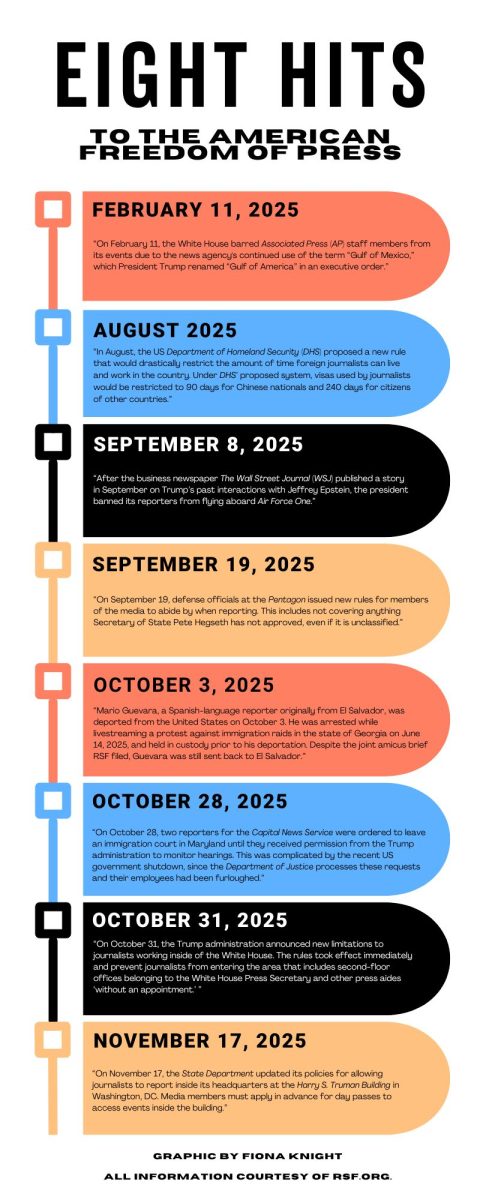
The categories of people whose rights to free speech and expression have been and are continuing to be violated include dissenting police officers, public servants, journalists, teachers, and even late-night talk show hosts, including Mr. Jimmy Kimmel. The argument, behind which the current administration hides to justify their targeting of ideological opponents, is that they are defending the nation’s honor and doing Americans a favor by shooting down, “Hate speech.” The harsh reality of this “hate speech,” however, is not that it is anti-American, but rather that it is critical of far-right ideologies and methods of conduct like those exercised by the Trump Administration. “Hate speech,” as dictated by current government officials, can be as simple as the press continuing to refer to the gulf between Texas and Mexico as “The Gulf of Mexico,” rather than by President Trump’s chosen name for it: “The Gulf of America.” Failure to obey this small change led to the Associated Press, for example, being banned from the White House for engaging in supposed violent resistance to the government and expressing anti-American sentiment, as reported by rsf.org.
A more domestic example of free speech censorship is the drafting of a plan by the government to, “Require visa applicants from dozens of countries to provide social media, phone and email histories for vetting before being allowed into the US,” as reported by theguardian.com. Individuals looking to visit the United States from countries like Ireland, Australia, France, Germany, and Japan would be required to hand over their social media history, telephone numbers, and email addresses from the last five years if this plan were to be passed. In doing this, the government looks to vet individuals who “endanger” and do not meet the values of the country, which is a category that will extend to those who have spoken out against President Trump and his cabinet. Again, this speech and protest of the current administration is completely legal, leaving the world wondering if legality is even in the cards as a defining principle of modern American government.
Censorship of supposedly hateful or damaging media has, for many years, directly contradicted the principles of American freedom of speech. In 1989, the Supreme Court Case known as Texas v. Johnson, for example, established that, “The government may not prohibit the expression of an idea simply because society finds the idea itself offensive or disagreeable,” as reported by aclu.org. This court case serves to protect the idea that free speech knows no strict bounds, because it is the sharing and combination of diverse viewpoints that open individuals’ minds to new ideas, rather than keeping them single-faceted forever.
The boundaries of free speech exist. However, they extend far more leeway to the people than is being granted by the Trump Administration. Accusations of free speech as being, “Hate speech,” for example, are not specific and relevant enough to fall under the restrictions of expressive speech established by the Supreme Court case Brandenburg v. Ohio, which serves to maintain the quality of American society by prohibiting incitement and violent talk. The blatant disregard by government officials for the foundational principles of the Constitution that dictate both the unequivocal and extended rights of the American people represents a direct decline in the overall liberty of the public. Restrictions on speech are simply the first step in this oppression.
When society reaches a point where journalists and regular citizens fear deportation and active slander at the hands of the government, simply for voicing their opinions on the news and various social media platforms, one is left wondering if the United States really is a land of free speech in the modern-day and age. In times like these, it is hard to distinguish between governmental policy and strongarming by politicians to maintain the purity of their reputations and administrations. But it is easy to recognize general acts that contradict principles of respect between individuals. The government, as an institution made to serve by and for the American people, must be held accountable for respecting the rights of the general population to the fullest extent, not the one most convenient for the administration in office at the time.