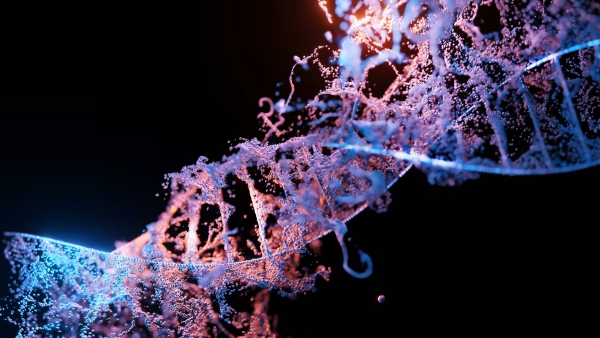




































It is a great time for technological breakthroughs. Although many of these can be taken for granted, a new renowned medical technology has emerged that has the potential to provide a cure for cancer. According to the National Library of Medicine, CRISPR (Clustered Regularly Interspaced Short Palindromic Repeats) gene editing technology is a new way to fight dangerous diseases, aid in the regeneration of important, previously irreplaceable cells, and even help to fight cancer at the molecular level. The way CRISPR technology works is essentially by cutting open a piece of DNA and either removing faulty genes that are causing problems, or inserting new genes to fix a problem. An endonuclease (Cas) is used to actually do the ‘cutting,’ which works with Cas nucleases to break strategic points in the DNA’s double helix to insert or remove genomes. For example, if a mutated gene is resulting in a cancer cell rapidly dividing throughout the body, CRISPR technology can be used to open the DNA double helix, remove the mutated gene, and replace it.
CRISPR technology has existed for a while, but its intensive usage in the medical field is still relatively new. CRISPR technology was first discovered by Francisco Mojica in 1993, as reported by the Broad Institute. CRISPR was first tested on a microbe (bacteriophage) in 2005 and first used to actually affect DNA targets in 2008 at Northwestern University in Illinois. CRISPR gene-editing technology was first used to edit genomes in 2013 by Feng Zhang from the Broad Institute of MIT and Harvard. According to the National Urea Cycle Disorders Foundation, one successful application of the CRISPR gene editing technology was with KJ Muldoon, a newborn who in 2025 was born with a rare, lethal urea cycle disorder. His family agreed to treat him with experimental CRISPR technology, and it was a success, making the symptoms of his condition much more manageable. His mother, Nicole Muldoon, expressed her gratitude for how this technology helped her son. She said, “Thanks to this team, he’s hitting milestones that we get to celebrate together.”
Unfortunately, tragedies surrounding gene editing have held advancements in the technology back. For example, according to the Library of Medicine, Jesse Gelsinger, an 18-year-old with the genetic ornithine transcarbamylase deficiency, was part of a clinical trial to edit his genome and cure him of the disease. However, the technology had a much stronger effect on him than was expected, ultimately leading to his organs failing and causing his death just four days after treatment. Additionally, according to Boston Children’s Hospital, CRISPR gene editing technology can worsen a phenomenon known as retroposition, or “Jumping Genes,” which are typically harmless but can result in rearrangements of DNA that cause cancer. Although there are now safety checks in place to ensure that retroposition is monitored when CRISPR technology is used, concerns of potential dangers continue to slow the advancement of progress in the field, although many have been satisfied throughout recent years.
Overall, advances in CRISPR gene editing technology have the potential to save countless lives now and in the future. Although it can be dangerous, safety regulations have been put in place to monitor known risks and minimize any chances of problems arising. Further development of this technology could help fight previously incurable diseases and even fight cancer. While the technology is not perfect yet, the progress that has been and continues to be made is extremely promising.