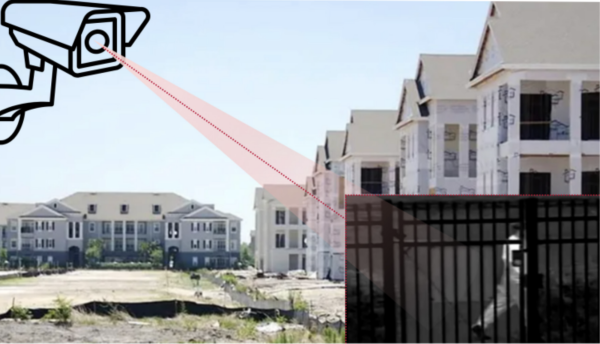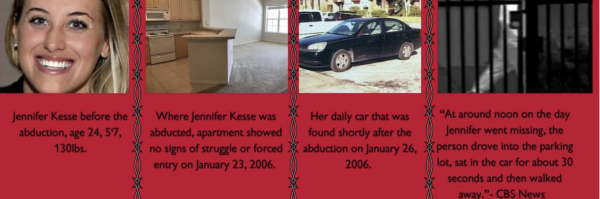





















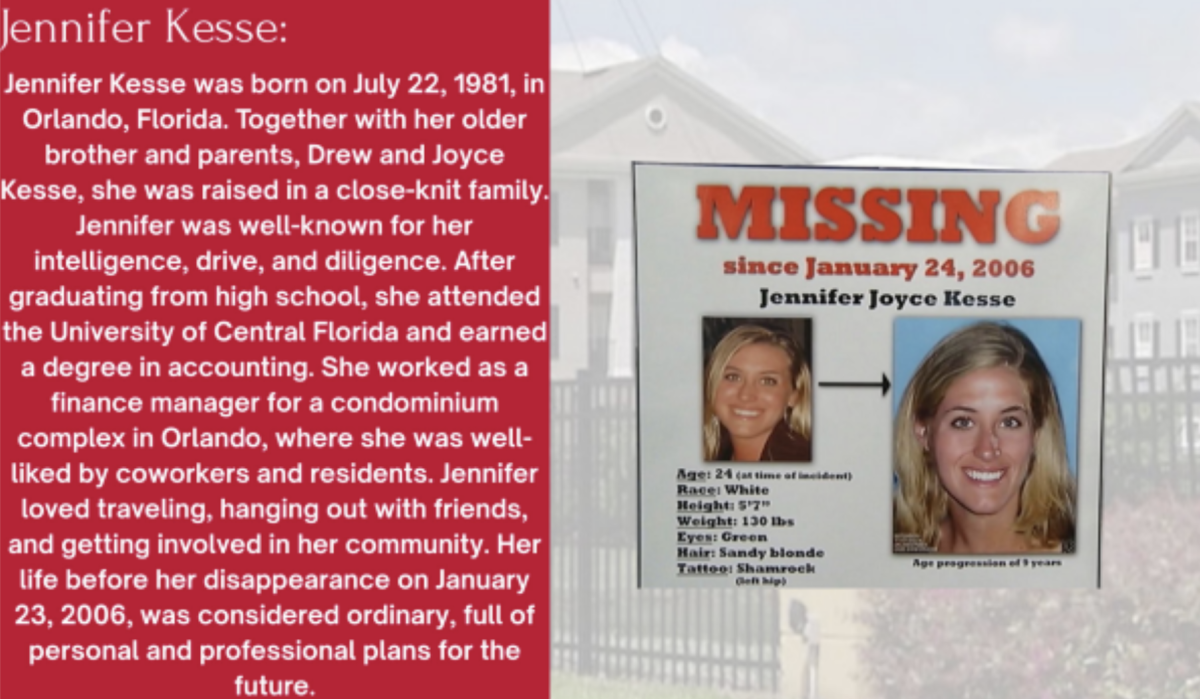
A University of South Florida study revealed that A over 500,000 people in Florida have been victims of human trafficking, making Orlando, Florida, third in the nation for trafficking. On January 23, 2006, Jennifer Kesse, a 24-year-old female, vanished from her apartment complex, Mosaic at Millenia, in Orlando, Florida. Soon, her car was found East of where she lived in Huntington on the Green. Footage shows an unidentified “person of interest,” walking out of her car after sitting in it for approximately 32 seconds. The suspect was then caught walking past a gate, away from the car. Shortly after that, the security footage glitched, showing only footage
where his head was blocked by the gate pillars.
It has been 20 years since the abduction, and still nobody has found out who the abductor is or where Jennifer Kesse herself is. As of October 2025, Kesse’s father announced that investigators found new DNA evidence that narrowed the pool of suspects substantially. Kesse was last seen to have been leaving Central Florida Investments Timeshare Company (CFI) in Ocoee, where she worked as a finance manager, at approximately 6:00 P.M. She later made a phone call to her father at around 6:15 P.M. and afterwards spoke with her boyfriend at 10:00 P.M. Kesse and her boyfriend had a tradition of texting or calling each other before she went to work in the mornings, so it was strange when Kesse failed to do this the following day. Her boyfriend called, thinking maybe she slept in, but the call went straight to voicemail. When she did not arrive at work, her boss contacted her parents to let them know. Both the fathe and mother immediately set out on a two-hour drive from their house to check up on Jennifer and make sure she was doing ok. When they arrived, her car was missing, yet nothing appeared unusual inside her actual apartment, except for the fact that she wasn’t in it. That night, the Orlando Police Department organized several search parties on foot, on horseback, by boat, by helicopter, by car, and by ATV.
“We look for Jennifer pretty much everyday,” Drew Kesse stated when speaking out about his daughter’s disappearance to Fox 13 News. Jennifer Kesse disappeared in 2006. For almost two decades, her parents, Drew and Joyce Kesse, have kept searching for answers. Although the case went cold for many years, new technology has provided the family with fresh hope. The Kesses are now collaborating with A.I. companies to reassess evidence that was previously thought impossible to analyze further. They hope they can clarify an ear on the footage from a suspect because, “An ear is just as good as eyes or fingerprints, or DNA,” as stated by Mr. Kesse. NASA also enhanced the film. The family was told the video was enhanced to the best it could get. However, A.I. stepped in, and the Kesses now have the side of the suspect’s head, providing much hope.
One of the biggest ways artificial intelligence has helped is by organizing and breaking down the 16,000-page case file. This huge collection includes reports, witness statements, and photographs that would take humans years to read closely. Knowing Jennifer is probably not alive, her parents still continue searching, stating, “We don’t believe anyone should go missing and not be found in this world.” A.I. has helped immensely by enhancing photos so well that they go from grainy to visible and significantly more useful for finding minuscule details that can take a case from cold to open. A.I. is also an additional tool being used alongside DNA testing and interviews; it has been helping the scientists and agents, not replacing them. Even though the case is still unsolved, A.I. has given new optimism that some of the unanswered questions of this case may finally be answered.
A.I. is not just helping crack Jennifer Kesse’s cold case but thousands of other cases. One of the biggest ways A.I. is used to solve and contribute to cracking these cases is facial recognition. This helps the police, family, and investigators narrow down the suspect list or even find the suspect directly.
In a recent case in Orange County, Florida, in 2021, a man was seen spying on a young female at her house late at night. The Ring doorbell camera could not quite pick up on the man’s face, providing little to no hope on who the unidentified person was. According to Click Orlando News, the Orange County Sheriff’s Department just recently subscribed to Clearview A.I., a technology app that specializes in facial recognition from blurry or grainy photos. Clearview A.I. showed the suspect to be a man named Bobby James Harris, a registered sex offender. Without Clearview, the Sheriff’s Department would struggle to find Bobby’s identity. This prime example shows how A.I. is truly helping so many cases be solved as it works alongside, not replacing or against, humans trying their hardest on their mission: to find who commited these monstrous misdemeanors. It is success stories like this that keep individuals motivated to pursue and possibly solve even the most difficult cold cases, specifically those similar to the case of Jennifer Kesse’s disappearance.